Date: 2026-08-13
Connecticut's Model for Legislating Research Infrastructure
Open access · Free to read
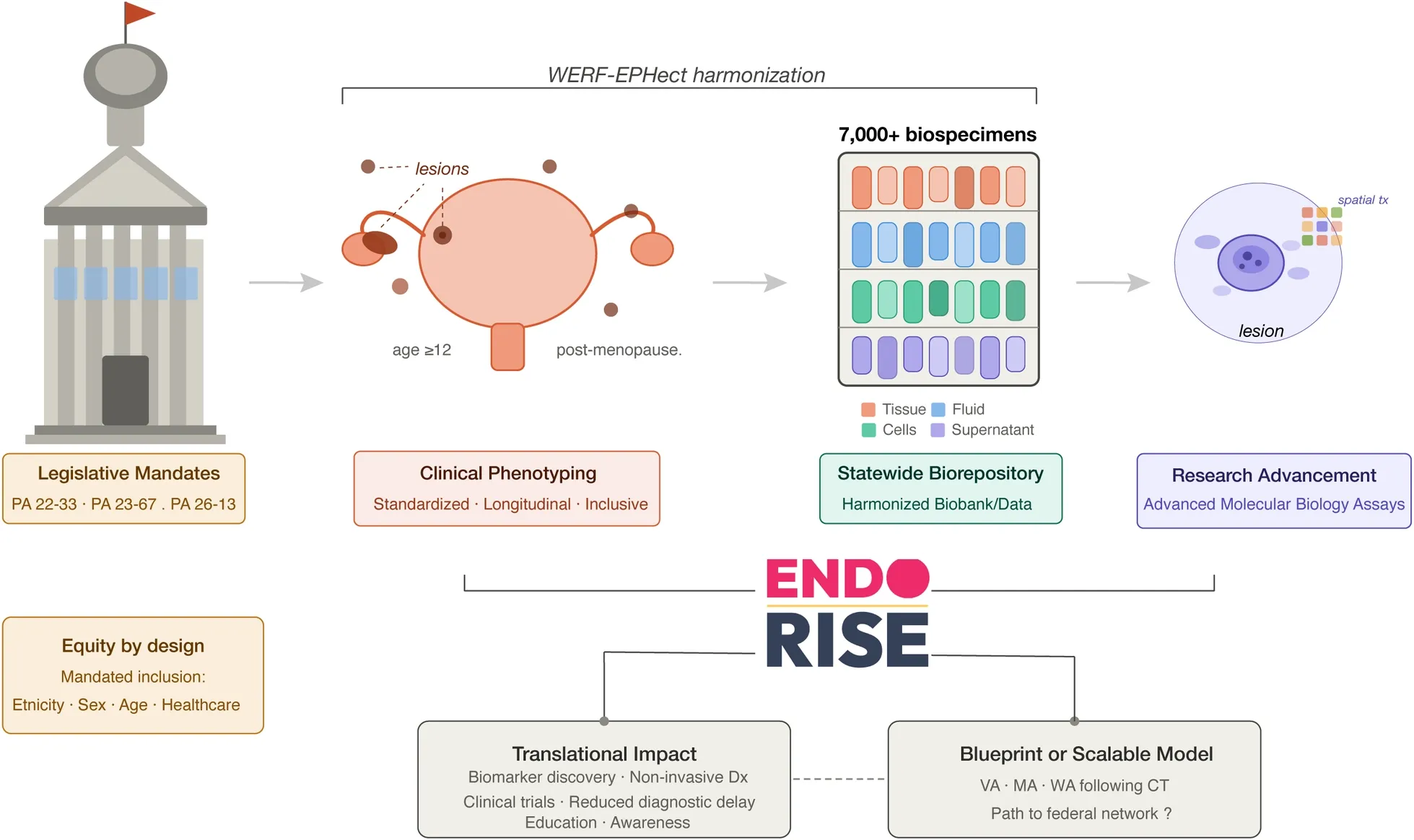
We are proud to share a major milestone for EndoRISE. Our team's article, "Legislating infrastructure: a state-level model to accelerate endometriosis research and women's health equity," has been published in Frontiers in Reproductive Health. It describes how Connecticut wrote research infrastructure into law, and what the first years of EndoRISE have shown.
Why This Matters
Endometriosis affects roughly one in ten female-born individuals, yet diagnosis is still delayed by about ten years on average. Research investment in conditions like endometriosis has long lagged behind their burden. The article describes how Connecticut took a different approach: building the research infrastructure into state law.
What the Article Covers
From legislation to a working program. Connecticut was the first state in the U.S. to pass endometriosis-focused legislation, and it did so unanimously. Public Acts 22-33 and 23-67 led to EndoRISE, a statewide data and biorepository program co-led by UConn Health and The Jackson Laboratory.
From collection to distribution. About 7,000 biospecimens were collected in the first two years under harmonized protocols. Sample distribution has now begun, reaching academic laboratories and biotechnology start-ups, both national and international.
Built to global standards. The biorepository follows the WERF-EPHect harmonization standards and is designed to be compatible with emerging technologies such as single-cell and spatial transcriptomics.
Equity as a design principle. The legislation requires inclusion of historically underrepresented groups. EndoRISE enrolls patients across multiple hospital networks in Connecticut, offers translated study materials, expanded eligibility in 2025 to adolescents and postmenopausal individuals, and provides continuing education for school nurses, primary care providers, pediatricians, and OB-GYNs.
A model others can learn from. The article compares Connecticut's approach with efforts in other states and at the federal level, and makes the case for linking state programs into a coordinated multi-state network.
A Legislative Milestone, Too
On May 14, 2026, Connecticut passed legislation establishing the Endometriosis Working Group as a permanent, legislatively established body. The article also acknowledges the leadership of Representative Jillian Gilchrest and the members of the Endometriosis Working Group, whose work helped make EndoRISE possible.
Looking Ahead
The authors are clear that infrastructure alone is not the finish line. The true measures of success will be validated non-invasive diagnostics, improved treatments, shorter diagnostic delays, and more equitable access to care. EndoRISE is committed to tracking those outcomes as the program grows.
Thank you to the Endometriosis Working Group, our participating hospitals and clinicians, our partners at UConn Health and The Jackson Laboratory, and above all the patients who chose to take part in EndoRISE.
Courtois ET, Roy L, Kuljancic J, Mullaj K, Lockshire D, Luciano DE. Legislating infrastructure: a state-level model to accelerate endometriosis research and women's health equity. Front Reprod Health. 2026;8:1918764. doi:10.3389/frph.2026.1918764

State-mandated infrastructure accelerates endometriosis research: the Connecticut EndoRISE model. Figure 1 from Courtois et al., 2026 (CC BY 4.0).